Every number cited. Every method published. Every result reproducible.
Praxis assesses armed-conflict, country, maritime, sanctions and macro-financial risk from authoritative public sources, and serves every result through one API: to analysts in the workbench, to your systems over HTTP and to AI agents over the Model Context Protocol.
Read the documentation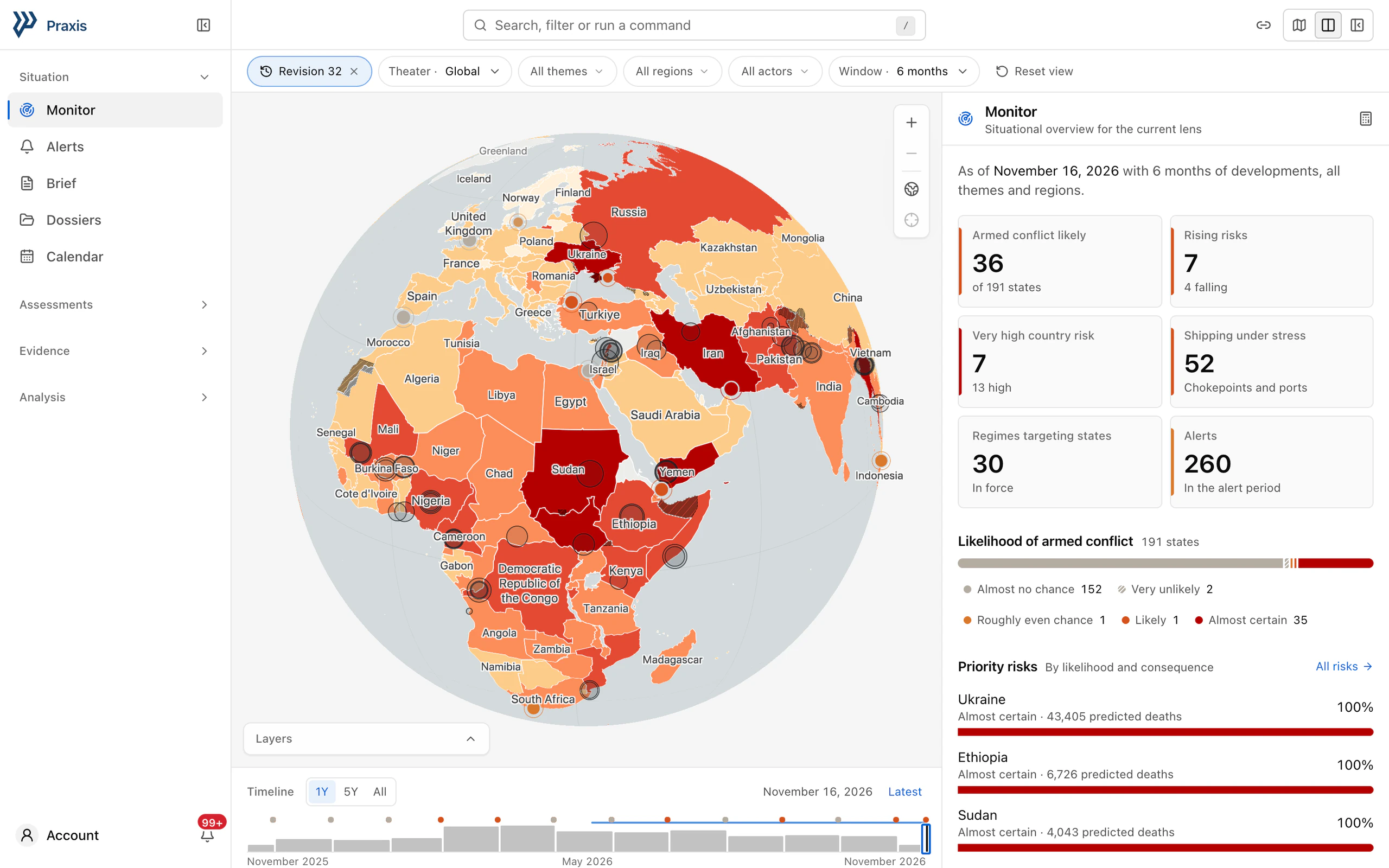





From the public record to a decision you can defend.
Praxis reads authoritative sources, assesses them with one published methodology and keeps every answer reproducible.
Assess risk
Armed-conflict, country, maritime, sanctions and macro-financial risk for every state, from one methodology.
Monitor change
Alerts when a likelihood band, a risk class or a conflict level moves, and watchlists that follow you across devices.
Brief with sources
Cited briefs for any lens and dossiers for any actor, ready to share as Markdown.
Look ahead
Conflict forecasts, macroeconomic projections, debt fan charts, scenarios and verified prediction markets.
Reproduce any number
Pin a date and a data revision and get the same answer later, even after a source corrects its data.
Integrate anywhere
Analysts, your systems and AI agents read the same versioned API, so every figure matches everywhere.
From cited source to reproducible answer.
One pipeline carries every record from the catalog to every client, and nothing on the way is entered by hand.
- 01
Cite
A reviewed catalog lists every source: research datasets held in the platform's own database, and public APIs read on their own cadence.
- 02
Record
Each delivery is validated whole and recorded as a new data revision. Nothing is overwritten.
- 03
Assess
Published, versioned models compute every assessment from the revision, the as-of date and the methodology release alone.
- 04
Serve
One versioned API serves every result with its provenance to the workbench, your systems and AI agents.
Built so that every number can be checked.
Each guarantee is enforced by the platform's code and tests, not by a policy document.
Cited sources
Every record comes from a cited source of a reviewed catalog. No client can submit source data.
Published method
Every number comes from a cited, versioned model applied to data that names its source.
Reproducible results
Name the data revision, the date and the methodology release, and any assessment is computed again, identically.
No look-ahead
Nothing dated or published after the as-of date influences a result at it.
Nothing overwritten
Every change is a new data revision, so every past state of the data stays readable.
One API for every client
The workbench, your systems and AI agents read the same API. The interface computes nothing itself.
Denied by default
Every operation except the readiness probe is authenticated and authorized.
Enforced, not promised
Module boundaries, determinism and published outputs are enforced by tests, not by convention.
Three ways in, one source of truth.
People, systems and AI agents read the same versioned API, so a figure in a brief, a dashboard and an agent's answer is the same figure.
Workbench
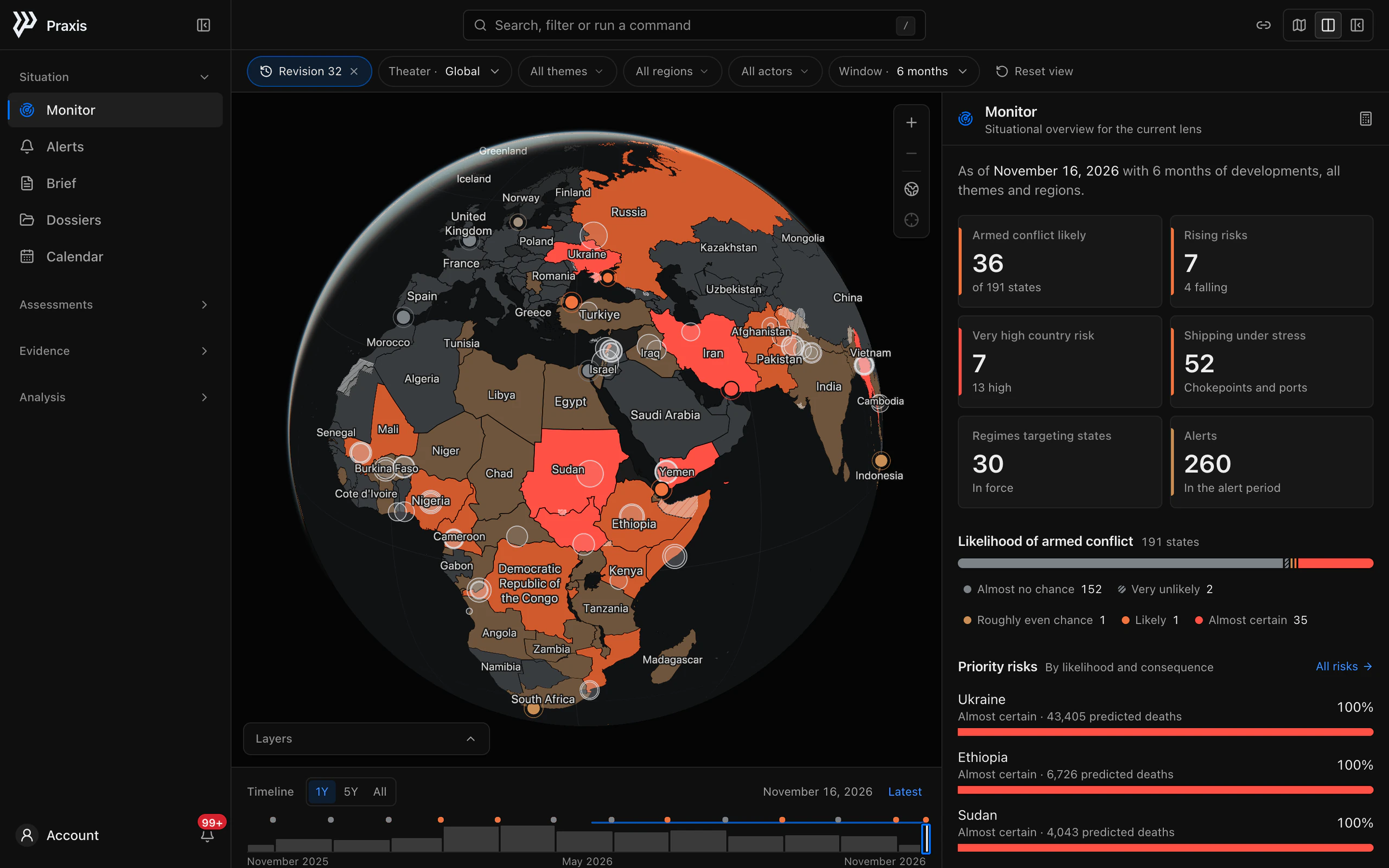
Monitor, assess and brief in the browser: modules over one lens, a globe, a time machine and a command bar.
- Links that reopen a view with the same numbers
- Alerts and watchlists that follow you across devices
- Briefs and dossiers exported as Markdown
HTTP API
One versioned API with an OpenAPI 3.1 contract. Every response states the data revision, the lens and the methodology release behind it.
- Generate clients in any language
- Conditional reads and stable error codes
- Briefs and dossiers as JSON or Markdown
Model Context Protocol
The read operations of Praxis as tools for AI agents, with the same credentials and the same answers as the API.
- Tools generated from the API's own definition
- Read-only by construction
- Answers pinned to a date and a revision
Answers for the questions that change plans.
Country and sovereign risk
Which states are becoming riskier, and why?
Armed-conflict exposure
Where is armed conflict likely in the next twelve months?
Maritime and supply chains
Which corridors and ports are disrupted, and who depends on them?
Sanctions and statecraft
Which regimes target whom, and when do they lapse?
Briefings and dossiers
What does leadership need to know today, with sources?
AI agents
How can our assistants answer with numbers they can cite?
What teams ask first.
Answers about Praxis's data, methods and access. Detailed questions go straight to the team.
From a reviewed catalog of public sources: research datasets such as UCDP and Correlates of War, held in the platform's own database, and public APIs of the IMF, the World Bank, the BIS, UNHCR, ViEWS, the EU Sanctions Map, GDACS, USGS, Wikipedia and prediction markets. Every record names its source, license and citation, and no number is entered by hand.
By a published, versioned methodology. Every model states its procedure, parameters, references and limitations, and every response names the methodology release that produced it, so anyone can check which method a number came from.
Yes. Pin the as-of date and the data revision, and the platform returns the same numbers for as long as the same methodology release is deployed, even after a source corrects the data behind them.
Analysts use the workbench in the browser. Systems call the HTTP API with access tokens from your identity provider. AI agents use the Model Context Protocol endpoint with the same credentials. All three read the same API.
Yes, by agreement. A dedicated deployment runs behind your gateway and identity provider with its own PostgreSQL database, and your scheduler decides when it synchronizes.
Pricing depends on the access paths, the number of people, systems and agents, and the deployment model, so it is agreed with each organization. Request access and tell us what you need.
Bring cited, reproducible intelligence to your next decision.
Tell us which questions you need to answer and how you want to read the answers: in the workbench, over the API or through your AI agents.
Logos do not imply endorsement.